
THERMAL IMAGING | NIGHT FLIGHT CAPABILITY | CHARLESTON, WV
Search And Rescue Aerial Support
UA-Visions provides aerial search and rescue support for public safety agencies and private individuals across West Virginia. We operate a thermal imaging drone with night flight capability — a civilian operator actively supporting search and rescue missions in the state.
For active search and rescue emergencies, call us directly at 304.807.9410. We respond to emergency requests as quickly as possible and can mobilize for urgent missions across West Virginia.
Why Aerial Support Changes Search Outcomes
West Virginia's mountains, ridgelines, dense forest, and remote hollows make ground-based searches slow and dangerous. A search team on foot covers a fraction of the terrain a drone can survey in the same amount of time. In a missing person situation, time is the most critical variable.
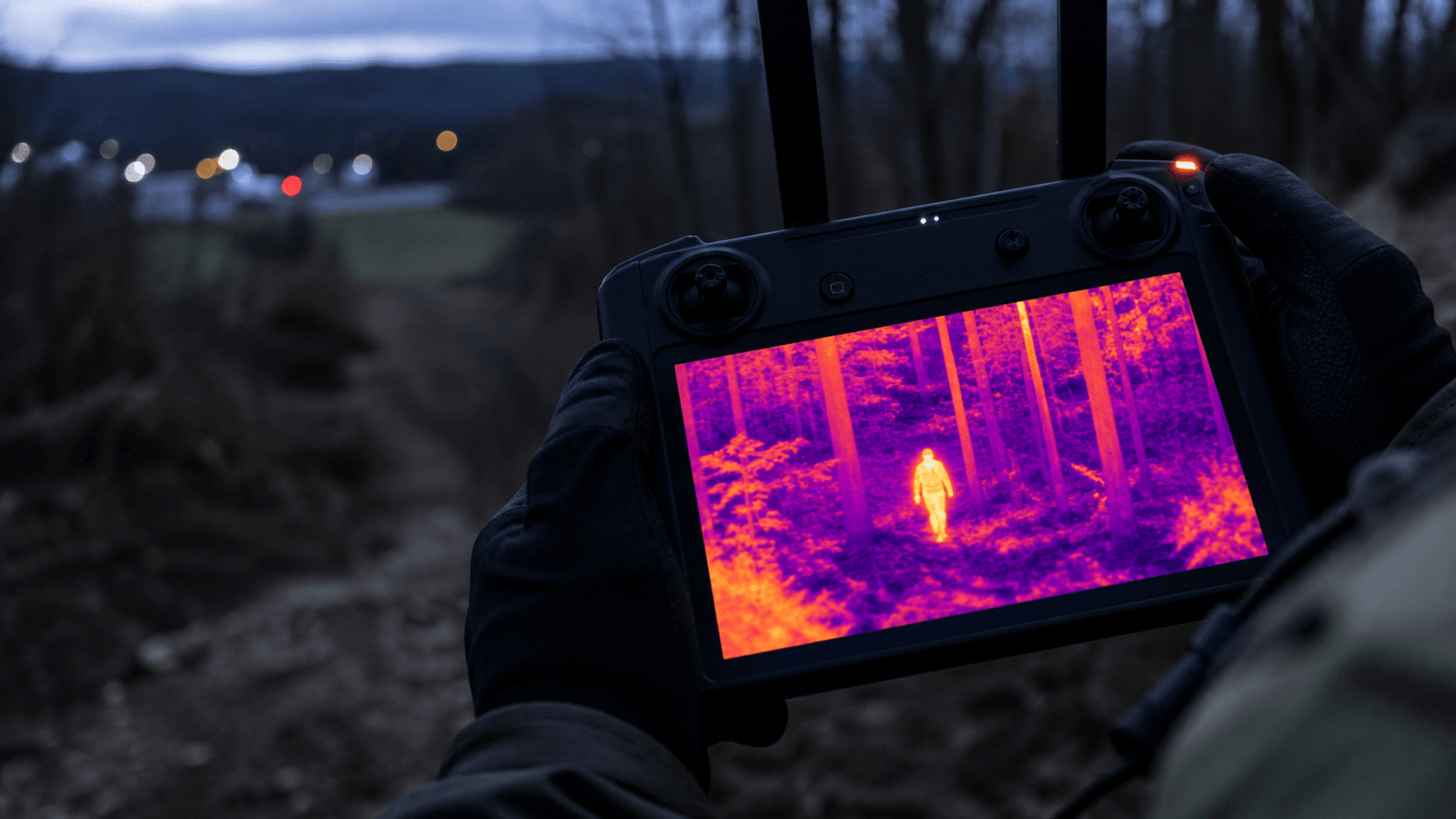
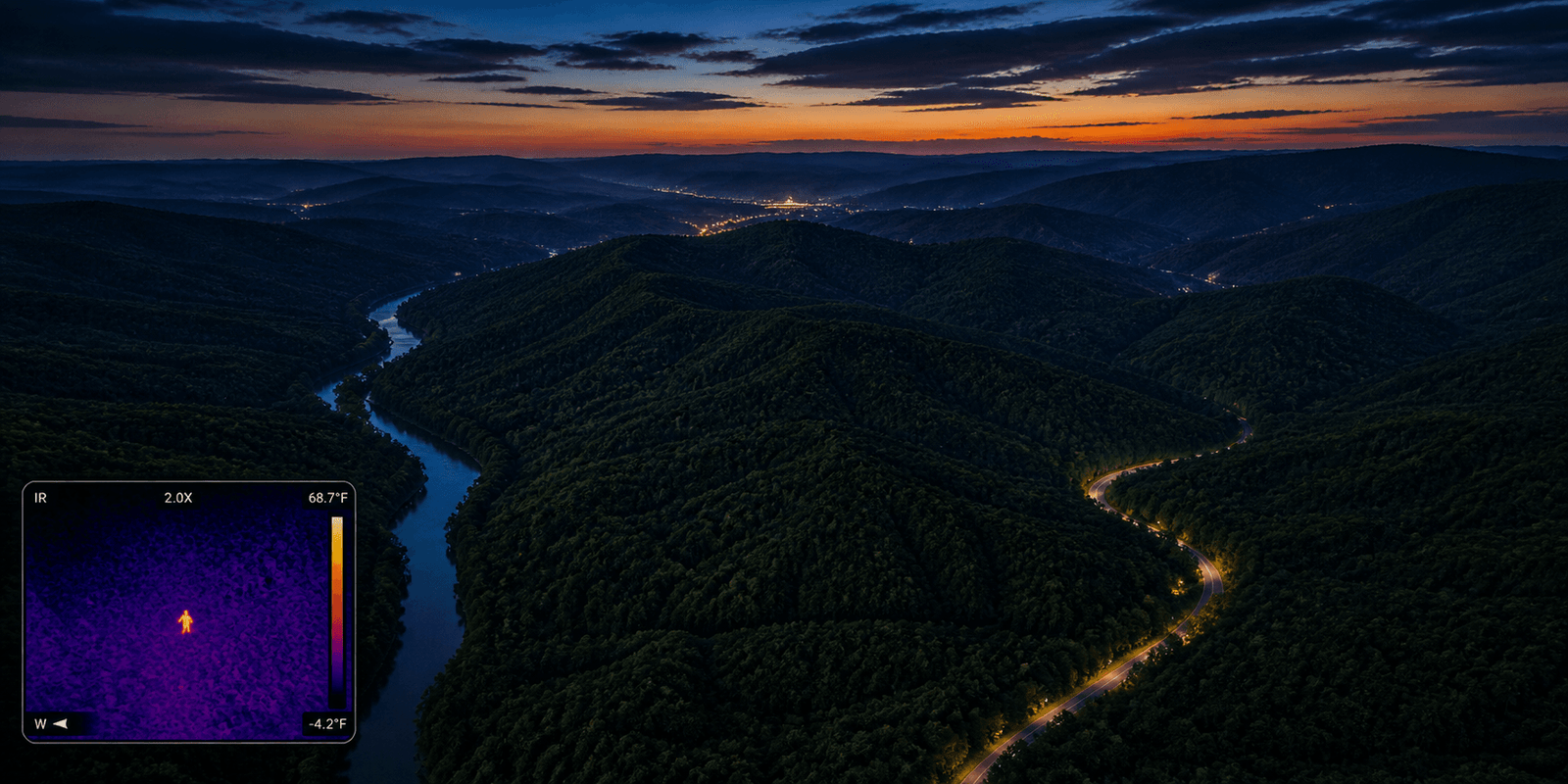
UA-Visions operates a thermal imaging drone that detects body heat through darkness and light vegetation. A person lost in the woods at night — impossible to spot by flashlight or ground crew — shows clearly as a heat signature on a thermal camera. We can fly search patterns over rough terrain, stream live thermal footage to ground coordinators, and cover hundreds of acres in a fraction of the time it takes a foot team to clear the same ground.
We partner with law enforcement agencies, fire departments, emergency management offices, and search and rescue organizations across West Virginia. We also provide private aerial search assistance for families and individuals when time is critical and official resources are stretched.
UA-Visions SAR Capabilities At A Glance
Thermal Imaging: Detects body heat through darkness, light vegetation, and low visibility conditions that ground teams cannot safely operate in.
Night Flight: FAA-authorized night operations allow us to fly after dark when many missing persons situations become most critical.
Live Video Feed: Real-time thermal and visual footage streamed directly to ground coordinators so the search team can direct response based on what the drone sees.
GPS Tracking: Precise coordinate logging of search patterns and any identified heat signatures for ground team navigation.
Rapid Deployment: Based near Charleston, WV with equipment ready to mobilize for missions across the state.
Terrain Coverage: Effective over mountain ridgelines, dense forest, river corridors, open fields, and the rugged hollows that make West Virginia searches particularly difficult.
What Thermal Imaging Sees That Eyes Cannot
Standard cameras — including night vision — rely on reflected light. Thermal cameras detect heat energy directly. A person lying still in dense brush at 2am is effectively invisible to a spotlight or night vision camera. On a thermal display, they appear as a bright heat signature against the cooler background of the forest floor.
This distinction matters in West Virginia searches because many missing persons are found in exactly those conditions — elderly individuals with dementia who have wandered into wooded areas, hikers who fell and cannot move, children who have hidden in brush. These situations favor thermal aerial search over any other method.
UA-Visions carries a dedicated thermal payload on the DJI Mavic 3 Thermal platform. The thermal sensor operates independently of visible light, meaning cloud cover, smoke, and darkness do not affect its effectiveness the way they affect standard cameras. We can fly effective search patterns in conditions that would ground a visual-only operator.
Who UA-Visions Supports
UA-Visions works with both public safety agencies and private individuals depending on the nature of the situation. Our aerial SAR support is available across West Virginia with priority response for the Charleston area and surrounding counties.
Law Enforcement Agencies
Sheriff departments, municipal police, and state law enforcement agencies can request aerial thermal support for active missing persons searches, fugitive searches, and evidence documentation. We operate under the direction of the incident commander and integrate into existing search operations.
Fire Departments And Emergency Management
Fire departments and county emergency management agencies can use our aerial thermal support for wildfire perimeter mapping, structural fire documentation, hazmat scene overview, flood response area assessment, and search operations following natural disasters or accidents.
Private And Family Requests
Families searching for a missing loved one when official resources are limited or unavailable can contact UA-Visions directly. We assess each private request individually. Where we can safely and legally support a private search, we will work directly with the family and coordinate with any active official search operation.
Equipment And Operational Capability
Our search and rescue aerial capability is built around dedicated thermal and night flight equipment — not consumer drones pressed into service for an emergency. This is how we operate on every SAR mission.
DJI Mavic 3 Thermal Platform
Our primary SAR drone carries a dual-sensor payload combining a 48MP visible light camera with a dedicated FLIR thermal imaging sensor. The thermal sensor operates in complete darkness and detects temperature differences as small as 0.5 degrees Celsius — sufficient to clearly distinguish a human heat signature from surrounding terrain, water, and vegetation.
Night Flight Authorization
UA-Visions holds FAA Part 107 certification and operates under night flight waivers and authorizations where required. Flying after dark in support of a SAR operation requires proper certification and FAA compliance — we have both. We do not operate outside FAA regulations in emergency situations.
Live Video Streaming
Thermal and visual footage can be streamed in real time to ground coordinators, incident commanders, and family members in a staging area. This allows search leadership to make immediate deployment decisions based on what the drone sees rather than waiting for the pilot to return and report.
GPS Coordinate Logging
Every flight logs precise GPS coordinates for search patterns flown, areas cleared, and any thermal contacts identified. This data gives ground teams exact navigation coordinates to follow up on and provides a documented record of the aerial search coverage for after-action review.
Extended Flight Duration
Multiple battery sets allow for extended aerial coverage without significant gaps in search pattern continuity. For large-area searches, we can maintain near-continuous aerial coverage over priority search zones.
How a SAR Mission Works With UA-Visions
1. Initial Contact
Call us at 304.807.9410. Provide the location, the nature of the search, the incident commander's contact if it's an official operation, and any known last seen point. We assess the mission immediately and confirm whether we can mobilize.
2. Deployment
We mobilize with the drone, thermal payload, extra batteries, and communications equipment. For missions close to Charleston, we can typically be on site within an hour of the call depending on conditions.
3. Coordination With Ground Teams
We brief the incident commander on our flight plan, search pattern, and live feed setup. We operate under the direction of the IC and coordinate airspace with any manned aircraft involved in the search.
4. Aerial Search
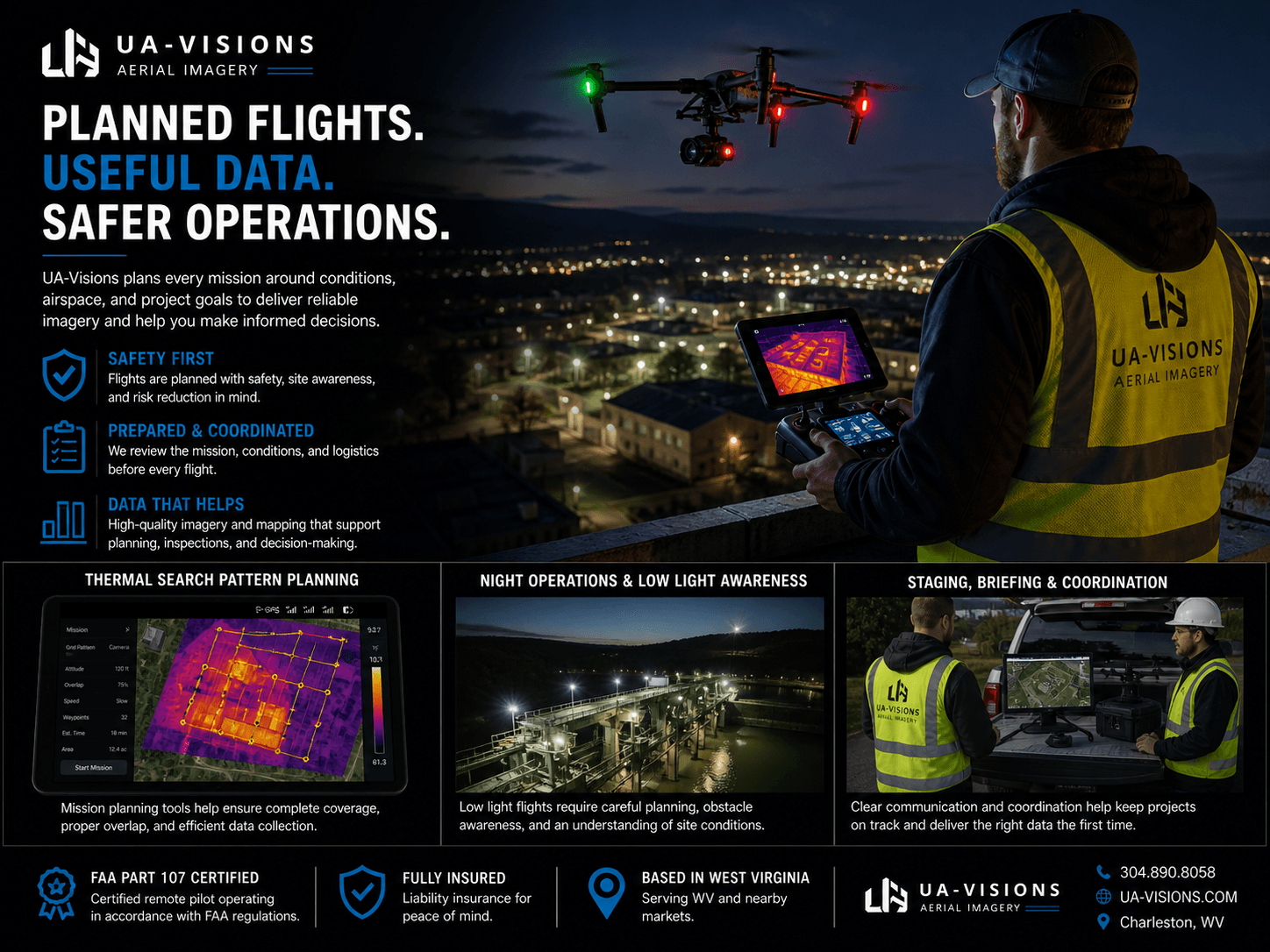
We fly systematic search patterns over the priority area. The pilot monitors the thermal feed while a second operator monitors the live stream and communicates contacts to the ground team in real time.
5. Contact And Follow-Up
When a thermal contact is identified, we provide GPS coordinates to ground teams immediately and maintain visual on the contact while ground crews navigate to the location.
Why West Virginia Searches Benefit From Aerial Thermal Support
West Virginia presents some of the most challenging search terrain in the eastern United States. Dense hardwood forest, steep ridgelines, narrow hollows, and limited road access make ground-based searches slow, resource-intensive, and dangerous for search team members.
Cell service is unreliable or absent across significant portions of the state, which means missing persons often cannot be located by phone ping. GPS devices and emergency beacons are not always carried by the people who end up needing rescue.
In these conditions, aerial thermal search provides an advantage that no ground-based method can replicate. A drone flying a systematic search pattern 200 feet above a ridgeline can clear terrain in minutes that would take a foot team hours to safely navigate — and it can do it in the dark.
Common search scenarios in West Virginia where aerial thermal support is most effective include hikers who have become disoriented on backcountry trails, elderly individuals with dementia who have wandered from rural homes, hunters who have not returned from remote terrain, and individuals in mental health crises who have left populated areas.
UA-Visions is based near Charleston, WV and can respond to missions across Kanawha County, Putnam County, Boone County, Lincoln County, and surrounding areas with reasonable drive time. For missions in more distant parts of the state, we assess each request individually based on urgency and available resources.
We are one of the only civilian drone operators in West Virginia actively maintaining the equipment, training, and FAA authorizations required to support nighttime thermal SAR operations. This is not a capability we offer occasionally — it is a core part of how UA-Visions operates.
Frequently Asked Questions
How Quickly Can UA-Visions Respond To A SAR Request?
For missions near Charleston, WV, we can typically mobilize and be on site within one to two hours of the initial call depending on current location and conditions. For missions in more distant parts of West Virginia, drive time is the primary variable. Call us at 304.807.9410 for an immediate assessment of whether we can support your specific location and timeline.
Does UA-Visions Coordinate With Official Search Operations?
Yes. When an official search operation is active, we operate under the direction of the incident commander and integrate into the existing search structure. We do not fly independently of official operations without coordination — doing so could create airspace conflicts with manned aircraft and interfere with the search. If you are a family member requesting private support during an active official search, we will contact the incident commander to coordinate before flying.
Can The Drone Fly In Rain Or High Winds?
Rain and high winds present real limitations for drone operations. Our equipment has weather resistance but is not waterproof. Heavy rain, thunderstorms, and sustained winds above approximately 25 mph create conditions where flying is unsafe or where the aircraft cannot maintain stable flight over terrain. We assess conditions at the time of each mission call and are transparent about what we can and cannot safely do. We do not fly in conditions that would put the aircraft or personnel at risk.
Is There A Cost For SAR Support?
For official public safety agency requests, we discuss cost on a case by case basis and do not let cost prevent us from supporting an active life-safety mission. For private family requests, we discuss our situation openly and work to find a workable arrangement. Contact us directly at 304.807.9410 and cost will not be the first conversation — finding the person is.
What Information Do You Need To Start A Search?
The most useful information at initial contact is the last known location or last seen point with as specific a description as possible, the terrain type (wooded, open field, near water, near roads), how long the person has been missing, any known medical conditions that affect mobility or behavior, whether an official search is already active, and the incident commander's contact information if one has been established. The more specific the last seen information, the more effectively we can plan a search pattern.
Can You Fly In Areas Without Cell Service?
Yes. Our drone operates on a dedicated radio control link that does not depend on cellular service. The pilot maintains direct radio control of the aircraft regardless of cell coverage in the search area. Live video streaming to remote coordinators requires a data connection, but core flight operations and thermal search are independent of cellular infrastructure.
Request SAR Aerial Support
For active emergencies, call us directly at 304.807.9410. For non-emergency inquiries about adding UA-Visions to your agency's SAR resource list, establishing a working relationship with your department, or discussing private search support, use the form below or email info@ua-visions.com. We respond to all non-emergency contacts within one business day.